
My Journey of Self-Discovery and Self-Love through Yoga
Thailand, a country that holds a special place in my heart as I found my own version of “Eat, pray, Love,” here in 2016 when I embarked on my first solo-backpacking trip. Now, I find myself again  in this beautiful country falling in love – with myself, with my partner and with yoga.
My yoga journey began in high school and persisted throughout my time in the Marine Corps. The repercussions of compounding ailments left me feeling hopeless, incapable and tired. There were times I could barely walk…I couldn’t tie my shoes and grew restless from months of uncomfortable, sleepless nights. I had no choice but to incorporate yoga into my life. I show up to the mat every day out of desire and necessity to feel better and be better. My story isn’t unique and the distressing reality is that many service members and veterans suffer from physical ailments that leave them feeling incapable of enjoying life.
 Although there are many yoga courses in Thailand and around the world, I applied for Embrace Energy Yoga School out of convenience. Unfortunately, the course did not deliver. The curriculum was confusing and due to Bangkok lockdowns, 8 hours of classes shrunk to 3 hours online. Despite some impressive technicality of the asana classes, this was not worth the $2,000. I googled our topics just to understand what the discussion was about! Additionally, Their 200 hour Yoga (20 day) YTTC said it included: “Retreat and sightseeing etc., Yoga school T-shirt, Yoga therapy & Ayurvedic massage and 3 months membership at the studio,” but was excluded without explanation or discount.
 In comparison, I found a last minute course on the beautiful island of Kho Phangan., a short flight and ferry ride away. The Wonderland Healing Center is located at the center of the island amongst tall palm trees, dense greenery, active wildlife and sounds of awakened nature. The energy is serene and paradisiacal compared to the skyscrapers and pollution I left behind…For half the cost, the course included…..
Here we had our own little community of yogis secluded from the hustle and bustle of life, with passionate instructors who are even willing to devote off-time to helping individuals grow and heal.
I hope you enjoy reading the rest of this article about my experience with their course and perhaps it will inspire you to embark on your own yoga journey to becoming a teacher or just a better practitioner. So, let’s begin…
The Yogic Philosophy
For nearly a decade I associated yoga with the physical expression of contortion. A practice for hyperflexible Instagram models who stretch and bend into beautiful asanas (postures/poses), but yoga is so much more…This ancient practice, developed nearly 5,000 years ago in India, is the art and science of healthy living.
Not only can yoga be performed in many physical practices, such as vinyasa, hatha and aerial, but yoga can be approached as a technology for inner wellbeing. I feel yoga aligns similarly to stoicism, which is oftentimes a glorified philosophy amongst the military community. 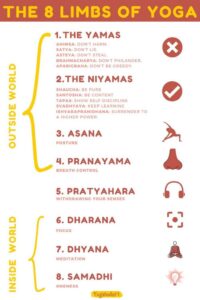
We begin to understand the perspectives behind yoga firstly through Patanjali’s scripture, Ashtanga. Ashtanga translates as “eight-limbs” and acts as a guideline on how to live a meaningful and purposeful life. Transcendence stems from a yogi’s ability to incorporate ethical standards and mindsets, codes of healthy habits, breath control balanced with continued presence, inward disconnection from the senses and integration of focus.
This information deepened my appreciation for yoga tremendously. Unbeknownst, this scripture inherently applied to my way of life as a Marine because mastery of the self manifests as the collective success of the organization. For example, the personal observance of Niyamas includes Svadhyaya or “self-study,” which uncovers our strengths, weaknesses, addictions, habit patterns and negative tendencies. This is where you begin to “Know yourself and seek self-improvement,” The Marine Corps’ first leadership principle.
Let’s acknowledge the rigid discipline from the first to last day of military service, and while Patanjali describes yogic discipline as Tapas or “disciplined use of energy and burning enthusiasm,” troops resonate more popularly with leaders like Jocko Willink who’s iconic expression is “Discipline Equals Freedom.” Check out the Marine Corps 13 Leadership Traits, which includes Enthusiasm, to further understand the similarities!
Let’s now focus on the 4 Paths of Yoga that additionally synthesize militaristic ideologies with yoga.
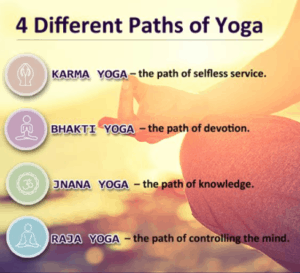 1. Karma Yoga – The path of action focuses on selfless service and generosity to others. The military exhibits this in volunteer and humanitarian efforts.
2. Bhakti Yoga – the path of devotion focuses on devotion, emotion, love and compassion. Bhakti yoga is simply loving ourselves and others through understanding and nonjudgment. The military needs work on this…
3. Jnana Yoga – the path of knowledge focuses on knowledge, wisdom, introspection and contemplation. The military encourages attendance of continued/higher education programs and offers many self-advancement courses.
4. Raja Yoga – the path of the mind & meditation focuses on meditation with pursuits of encountering and transcending thoughts of the mind. The military recognizes the importance of controlling the mind and body in order to endure stressful or combative environments. While intent may differ, troops and yogis may relate in this pursuit of clarity and calmness.
The mindset and manner in which we conduct life in the military can absolutely align with the practice of yoga.
 Learning a practice and making a practice a habit are very different though, so it’s important to find a meditation and yoga practice that fits your goals. If you’re interested in the Wonderland experience, then you have to check out their Inner Walk! “Inner Walk is an observational meditation practice that allows us to learn the art of quiet and objective observation.” The peaceful pacing acts as a physical cue that awaken us from our day-dream state back into the present moment. We only practiced two hours of freestyle walking over a three-day period, but Inner Walk is offered as a four-day journey. Remember, Anyone, at any age or lifestyle can begin their meditation journey!
So what about the physical practice?
The Anatomy of Yoga
Yoga Teacher Training Courses vary on the consistency and intensity of classes, so depending on your activity level I highly suggest researching (in detail) how physically active your course may be. Although we were challenged daily in a variety of yoga classes and taught  the families of asanas during technical clinics, I felt the emotional and spiritual journey sat center of the mat. I would have appreciated more emphasis on the physicality, practical application or sequencing of yoga, but this is simply the style that Wonderland delivers…I don’t say this out of disdain, but simply as an observation that may influence your decision to attend. Remember, your personal goals and preference as a student are important to getting the most out of a course!
With that being said, we learned quite a bit about the physiology of yoga, and I really enjoyed learning about this weird thing called Fascia! Fascia is a thin, extremely sensitive casing of connective tissues that surround and hold EVERYTHING in place – the organs, blood vessels, bones, nerve fibers and muscles. Despite it’s expansive network, fascia is undetected on X-rays, MRIs and CT scans.
 This video provides amazing insight on the connection between Fascia and Chronic Pain, something that every troop experiences during or after their service. In fact…
“Chronic pain affects between 31 and 44 percent of active-duty service members and is a leading cause of disability and reduced readiness.”
How do you relate to this experience? You’re at work, PT, or even relaxing at home and notice physical pain…it becomes uncomfortable, stinging, burning, growing and perhaps unbearable. You notify your command and they either; ignore you or send you to medical. Medical conducts this evaluation with functional movements, vitals, X-rays, MRIs and so on…only to diagnose you with absolutely nothing! You return to your unit without evidence of any ailments and are left feeling invalidated or accused of malingering. The military’s medical ignorance is a large scale pandemic on it’s own and instead of prescribing yoga as the panacea, our community is pumped with pills and outdated Western therapies that discredit or worsen our ailments. 
This article examines the profound impact yoga has on service members and “while those in the trenches say there is a long way to go before yoga can be broadly and systemically deployed within the military, the foundation is being laid for using asana, meditation, and other holistic therapies to make military personnel more resilient.”
 While yoga can be used as a physical remedy, also known as Yoga Therapy, it is just as effective for healing of the mind and soul. Unfortunately, the U.S. military often disregards the emotional and spiritual safety of troops, thus creating a desensitized and traumatized community that latches onto unhealthy coping mechanisms. Using yoga as a healthy mechanism to release “stuck” emotions can help service members and veterans heal from their traumas.
Perhaps you’ve had the experience? You’re wending your way through a long sequence, in the midst of an intense hip opener or back bend, when suddenly you have a wave of emotion that begins to well up inside you. Whether or not you have a clear idea of the source of that discomfort, you may have felt that the pose unleashed some past event or emotion that was living in your body. This is the emotional surfacing that comes through yoga practice.
My experience at Wonderland helped me understand that not only is this entirely normal, but it’s encouraged! I allowed myself to surrender in poses that I felt most vulnerable in, that I felt most ashamed in, that I felt most grief in…and after 8 years in the Marine Corps I gave myself permission to feel for the first time. I can’t describe how liberating this feels and I still have much to work on, but the foundation is laid to recover in a holistic manner.
And finally, 200 hours later, I am a registered yoga teacher!

This experience changed my life. I returned to Bangkok with an open heart, less judgment, loads of knowledge and wisdom that’ll enable me to be better human for the rest of my life. Yoga is a journey and philosophy that releases the best version of ourselves, so lease, please, please, consider attending a yoga course or retreat. I believe this experience can help our community during and after service beyond what is currently available for the masses. We deserve to feel healthy and happy, yoga can provide this.
I can’t wait to begin offering yoga classes for our community and please share my story to inspire readers to begin their yoga journey!
Stay Risky and Namaste!


